 RF Dance

Bachata
Key Highlights:
Cumbia originated on the Caribbean coast of Colombia as a mix of African rhythms, Indigenous flutes, and Spanish melodic influences.
The original Cumbia dance history includes the cumbiamba, a courtship ritual where women held candles while dancing in circles.
In the 1940s–1960s, musicians like Lucho Bermúdez and Pacho Galán modernized Cumbia with orchestral instruments, turning a folk rhythm into Colombia’s national music and popularizing it across the continent.
Today, Cumbia embraces electronic music, pop, hip-hop, and global rhythms.
Key figures like Aniceto Molina, La Sonora Dinamita, Luis Carlos Meyer Castandet, and Lucho Bermúdez shaped the evolution of Cumbia, ensuring its music and dance remain timeless.
If you’ve ever been to a party, wedding, or festival anywhere in Latin America, you’ve probably danced, or at least moved to, the beat of Cumbia. It’s one of the most loved and unifying rhythms across the continent, from Mexico to Argentina.
But have you ever wondered where Cumbia came from or how it got so huge in Latin music and dancing? The history of the Cumbia is full of passion, rhythm, and cultural exchange.
In this post, we’ll explore the Cumbia dance origin, how it spread through Latin America, and why this centuries-old rhythm still makes people move no matter where it shows up.
Born on the Caribbean coast of Colombia, the origins of Cumbia dance tell a story of how different worlds came together—African, Indigenous, and European—and created something completely new.
The Indigenous Peoples: The melodic instruments, primarily flutes known as gaitas and caña de millo, were brought by local tribes like the Kogui and Kuna. These were responsible for the eerie, soulful sound of traditional Cumbia.
The African Enslaved Peoples: Africans played the drums, which are the heartbeat of Cumbia. The rhythm was produced by instruments such as the llamador, tambora, and tambor alegre. The guacharaca, a scraping instrument that gives the beat texture, is the source of the well-known "chu-chucu-chu" sound.
The Europeans (Spanish): The instruments and structure were influenced by the Spanish, even though they did not directly create the rhythm. Cumbia gained a melodic twist that increased its dynamic as guitars and accordions gradually entered the mix.
The earliest cumbia, often called cumbia de gaita, was essentially a conversation between African percussion and indigenous flutes. It's a musical expression of mestizaje, the mixing of races, that defines Latin American identity.
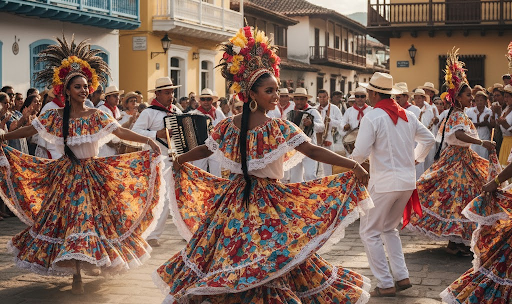
Originally, the Cumbia dance was a customary courtship rite. Known as cumbiambas, couples would dance in circles around bonfires, usually at night.
The women would hold one or two lit candles in their hands while making rhythmic waves while wearing vibrant traditional skirts. By gently pushing the man away, this candle served as a symbol of resistance and demonstrated that courtship would not be simple. The man, often holding a traditional hat (sombrero vueltiao), would try to woo her. This dance depicted the "battle that the man had to fight to conquer an indigenous woman," symbolizing the birth of a new coastal generation.
For many years, Cumbia stayed local to Colombia’s coastal villages. But as radio and records became popular in the early 1900s, the history of the Cumbia took a turn.
At this point, Cumbia received a complete orchestral makeover as the Big Band Era (roughly the 1940s to 1960s) arrived. Pioneering leaders such as Lucho Bermúdez and Pacho Galán combined pianos, clarinets, and strong brass sections (such as saxophones and trumpets) with the straightforward drum-and-flute rhythm.
They transformed it into a grand and polished sound that could rival major international dance forms. Cumbia became the national music of Colombia, with major thanks to Bermúdez's efforts.
Once Cumbia was established and recorded, it jumped borders in the mid-20th century, largely due to new technology, radio broadcasts, and traveling musicians. Let’s look at how the origins of Cumbia dance inspired new styles across Latin America.
Cumbia thrived in Mexico, helped along by Colombian accordionists like Aniceto Molina, who moved there. Mexican Cumbia became closely tied to Sonidero Culture, where DJs (sonideros) would play records in the street. A particularly unique style developed in Monterrey is called Cumbia Rebajada.
Sonideros would intentionally slow down the playback speed of the vinyl records, creating a slow, melodic, and sometimes melancholic version of Cumbia. This style is an identity marker for the local Colombian subculture.
Chicha, also known as Cumbia Amazónica, first appeared in the 1970s and came to represent the hopes and hardships of Andean migrants to cities like Lima. It blends the sounds of surf rock and psychedelic music from around the world with the Cumbia beat and traditional Andean melodies.
Chicha bands use electric guitars, frequently with wah-wah pedals and other trippy effects, in place of accordions. Bands like Los Mirlos (famous for "La Danza de Los Mirlos") became household names.
In the 1990s, cumbia gained enormous popularity in Argentine dance halls, or bailantas. However, a raw, aggressive style emerged in Buenos Aires' slums (villas miseria) by the late 1990s, during a dire economic crisis.
Cumbia Villera offers direct social commentary on poverty, crime, and the tenacity of the underprivileged working class through her raw, explicit lyrics, which are influenced by hip-hop and punk rock.
The roots of Cumbia dance are still changing after centuries. Cumbia is more diverse now than it has ever been. It has fully embraced the digital age, showing that this 400-year-old rhythm is still incredibly flexible.
We now hear Cumbia fused with everything: hip-hop, techno, dub, ska, and mainstream pop. The orchestra has often been replaced by digital tools, with modern instrumentation leaning heavily on synthesizers, electric guitars, electronic percussion (drum kits), and brass sections integrated into fusion styles.
You might not realize how often you hear Cumbia. Its rhythms are frequently used in popular media to set the perfect cultural atmosphere.
In Coco, Disney’s animated hit, Cumbia sets the mood for family and celebration.
The show Narcos uses Cumbia to capture Colombia’s cultural intensity.
Selena: The Series reintroduced audiences to the Queen of Cumbia, blending her pop style with traditional roots.
Cumbia's history is written by its incredible artists:
Lucho Bermúdez (Colombia): Listen to his work to understand how Cumbia moved from the folk scene to the big band era.
Luis Carlos Meyer Castandet (Colombia/Mexico): His upbeat hits like “La Historia” and “La Cumbia Cienaguera” were crucial in establishing the Mexican Cumbia sound.
Aniceto Molina (Colombia/Mexico): His song, “La Cumbia Sampuesana,” is a must-hear for fans of the guacharaca and accordion-driven style that spread across Mexico and Central America.
La Sonora Dinamita (Colombia): This ensemble, influenced by the big band era, is responsible for countless brass-heavy Cumbia hits that are still played at every Latin party today.
Cumbia is an invincible force. It is the most vibrant and complex cultural document in Latin America. The history of Cumbia dance demonstrates how art can endure for centuries, how celebration carries memory, and how rhythm becomes identity.
Whether you listen to the ceremonial gaitas of its birthplace, the psychedelic fuzz of Peruvian guitars, or the modern electronic beats of Raymix, you are engaging with a living legacy.
Experience Salsa, Bachata, or Cumbia with Orange County’s favorite homegrown dance school- RF Dance. Sign up now and get your first class for only $5!
Unedited reviews from people who walked in without a partner and without a clue.
“RF Dance is an amazing place. The instructors are encouraging and passionate, and my daughter looks forward to her classes every single week.”Sophia M.