 RF Dance

Different Styles of Salsa Dancing Explained
Posted on - 10 November 2025
What You’ll Learn in This Blog:
The main types of salsa dance and how they differ.
Key characteristics, movements, and origins of each style.
Tips on posture and how to dance each style confidently.
How to choose the right salsa style for beginners, social dancing, or performance.
Differences between linear vs circular salsa styles.
Have you ever watched two salsa dancers and felt like they were moving to completely different beats?
That’s because salsa isn’t just one dance—it’s a whole world of styles, each with its own rhythm, flair, and story. From the bold, show-stopping spins of LA style to the lightning-fast footwork of Colombian salsa, every version brings its own energy to the floor.
Understanding these styles not only helps you dance better but also lets you express your personality through every move.
In this guide, we’ll explore the most popular salsa styles—where they come from, how they move, and what makes each one unforgettable.
Let’s dive in and find your salsa groove!
I. Linear Salsa Styles (The ‘Slot Dancers’)
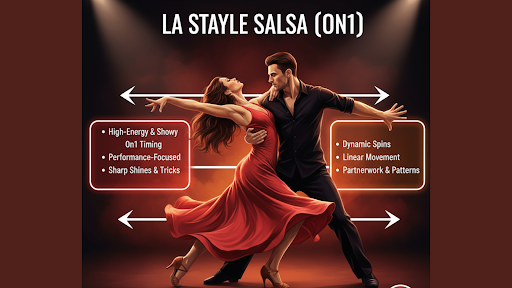
1. LA Style Salsa (On1)
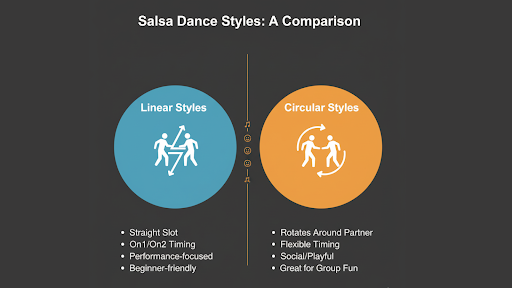
LA style is danced in a straight line (called "the slot") with the break step happening on beat 1—the downbeat, the most obvious pulse in the music. It's the most visually dramatic style, built for performance with multiple spins, dips, and arm styling.
The Key Movement:
Lead steps forward on 1 (left foot)
Rocks back on 2-3 (right-left)
Steps back on 5 (right foot)
Rocks forward on 6-7 (left-right)
The "break" happens on 1 and 5—these are your directional changes
Practice This:
Stand facing a line on the floor. Step forward across the line on 1, rock back behind the line on 2-3. Now reverse: step back on 5, rock forward on 6-7. You should stay within a narrow corridor, never drifting sideways.
The Music:
Tempo:Moderate (160 and 220 BPM)
What to listen for: LA dancers hit musical accents with arm flourishes or quick spins—the choreography mirrors the song's energy spikes
Common Beginner Mistake:
Over-spinning! Beginners see advanced dancers doing triple spins and try to replicate them immediately, leading to dizzy, off-balance dancing.
The Fix:
Start with single spins, master your spotting technique (turning your head quickly to find a focal point), and build muscle memory for 6-8 months before attempting multiple rotations.
At RF Dance Center in Orange County, we see this mistake every single week—enthusiastic beginners trying triple spins in week two. Our instructors break down the spotting technique step-by-step, so you can build a solid foundation before adding the flash.
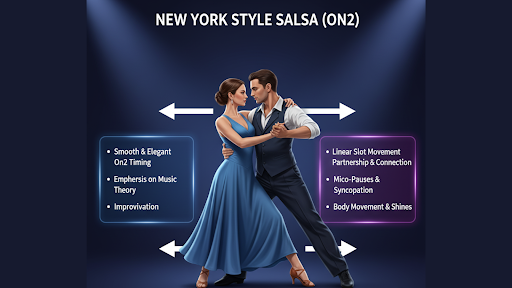
2. New York Style Salsa (On2)
NY style breaks on beat 2—the bass line, not the downbeat. This creates a smoother, more grounded look because you're dancing "in the music" rather than on top of it. The footwork is more compact, the upper body is quieter, and the emphasis is on connection and musicality rather than visual flash.
The Key Movement:
Lead steps forward on 1 (left foot)
Breaks back on 2 (right foot—this is your directional change)
Steps in place on 3
Steps back on 5 (right foot)
Breaks forward on 6 (left foot)
Steps in place on 7
The magic happens on 2 and 6—these beats are where the bass pattern hits hardest
Practice This:
Put on a salsa song and clap on every bass drum hit. Now step backwards on those hits. That's breaking on 2. Your body drops slightly on the break step—you're settling into the groove, not bouncing out of it.
The Music:
Tempo:Fast (160-200 BPM), but breaking on 2 makes it feel less frantic
What to listen for: Prominent horn sections, complex piano montunos, intricate percussion. NY dancers interpret the instruments—a piano break might trigger solo footwork, a horn hit might get a shoulder shimmy.
Common Beginner Mistake:
Counting instead of feeling. Beginners obsess over "1-2-3, 5-6-7" in their heads and miss the entire point—you're supposed to hear the 2.
The Fix:
Dance without counting for 30 seconds. Just step when it feels right. You'll start finding the 2 naturally. If you're counting, you're thinking. If you're thinking, you're not dancing.
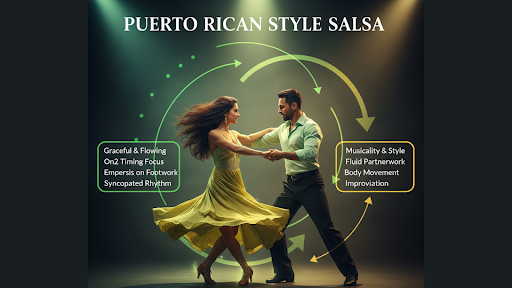
3.Puerto Rican Style Salsa
Puerto Rican style is the elegant cousin—flowing, graceful, with an emphasis on solo footwork (shines) and expressive arm styling. It can be danced On1 or On2, but it's distinguished by smooth weight transfers, controlled shoulder movements, and intricate footwork that showcases individual personality.
The Key Movement:
The basic can be On1 or On2, but the distinctive feature is the quality of movement
Each step involves a controlled shoulder roll
As you step forward on 1, your opposite shoulder rotates back slightly, creating subtle counter-body movement
On 2-3, the shoulders settle
This creates a wave-like motion through the torso
Practice This:
Step forward on your left foot. As you do, let your right shoulder pull back naturally, as if someone gently tugged it. Your left hip pushes slightly forward. Now step back, and let the opposite shoulder pull. This counter-rotation is the Puerto Rican signature.
The Music:
Tempo: Moderate (140-180 BPM)
What to listen for: Rich brass arrangements and romantic lyrics. Puerto Rican dancers often dance "in the song"—if the singer holds a note, they might pause; if the horns hit a crescendo, they'll accent it with a sharp turn or kick
Common Beginner Mistake:
Stiff hips. Puerto Rican style requires natural hip movement driven by weight transfer, not forced swaying. Beginners try to "move their hips" consciously, which looks mechanical.
The Fix:
Focus on bending and straightening your knees as you step. The hip movement is a side effect of proper weight transfer, not a separate action.
II. Circular Salsa Styles
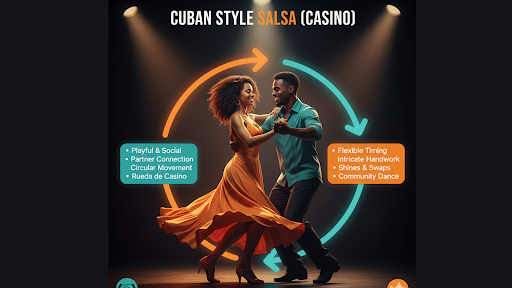
1. Cuban Style Salsa
Cuban salsa (called Casino in Cuba) isn't danced in a slot—you and your partner rotate in a circular pattern, constantly changing positions. The lead gives cues through hand pressure and body positioning rather than arm movements. It's playful, spontaneous, and social—less about looking polished, more about connection and improvisation.
The Key Movement:
Lead steps forward on 1 (left foot)
Rocks back on 2-3 while beginning to rotate the follow counterclockwise
On 5-6-7, the lead continues rotating, guiding the follower around in a circular path
By the end of the move, both dancers have switched positions
Your weight stays low (bent knees), and you pivot on the balls of your feet
Practice This:
Stand with feet together. Step forward on your left foot, rock back on your right while rotating 90° to your right, and close your feet. That rotation—that constant circular motion—that's Casino. Unlike LA or NY style, where you stay in a line, Casino feels like you're always traveling, constantly moving around your partner.
The Music:
Tempo:Moderate to fast (120-180 BPM)
What to listen for: Heavier percussion emphasis than salsa dura. Listen for the clave pattern (the rhythmic backbone)—Cuban dancers often emphasize the "3" side of the 3-2 clave. The music has more African drum influence, with layered percussion creating a thick, earthy sound.
Common Beginner Mistake:
Trying to stay in one spot. Beginners from the LA or NY style try to maintain a fixed position on the floor. Casino is about movement—you're constantly traveling, rotating, changing the geometry of your partnership.
The Fix:
Think of yourself as orbiting your partner like a planet around the sun. You're never stationary. Practice walking in a circle while maintaining connection with your partner's hand. Get comfortable with the idea that you'll end up on the opposite side of the room from where you started.
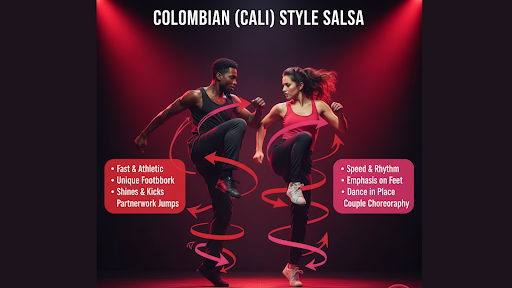
2. Colombian (Cali) Style Salsa
Colombian salsa is fast—relentlessly, impossibly fast. The footwork is rapid and intricate, with small, precise steps that match the percussion note-for-note. The upper body barely moves; all the action is from the waist down. This is the most athletic salsa style.
The Key Movement:
Quick tap on 1 (left foot)
Quick tap on "and" (right foot)
Slow step on 2 (left foot)
Hold on 3
Repeat on the other side, starting on 5
The taps are lightning-fast and barely leave the floor
Practice This:
Put on a metronome at 200 BPM. Now tap your left toe, right toe, left step—all within one beat. That's the speed you're working toward. Start at 120 BPM and gradually increase over months.
The Music:
Tempo:Brutal (180-220 BPM)
What to listen for: Bongos, timbales, and rapid piano montunos. Colombian dancers don't just dance to the music; they are the percussion section. Every tap corresponds to a drum hit.
Common Beginner Mistake:
Trying to go fast immediately. Your feet will tie themselves in knots. Cali style requires 12-18 months of drilling basic footwork at slow tempos.
The Fix:
Start at 100 BPM, nail the patterns, then increase by 5 BPM per week. Rushing this process leads to sloppy technique that's hard to unlearn.
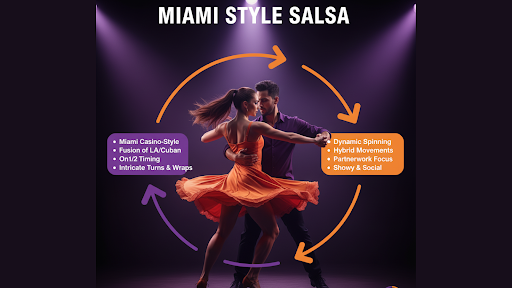
3. Miami Style Salsa
Miami style is the hybrid child of Cuban circular flow and LA's linear showmanship. You get the rotational patterns of Casino but with the dramatic spins, dips, and arm styling of LA style. It's technically challenging because you need to master both circular and linear movement patterns—and know when to switch between them.
The Key Movement:
Start in a circular pattern (Casino-style rotation around your partner)
On a musical accent or the lead's cue, transition into a linear slot
Execute 2-3 LA-style turn patterns (cross-body leads, inside turns)
Transition back to circular flow
This switching requires spatial awareness and strong lead-follow communication
Practice This:
With a partner, do 8 counts of Cuban-style circular movement (Dile Que No). On the next 8 counts, transition to a straight line and do a cross-body lead. Then rotate back to circular. The challenge is making the transition smooth—not jerky or confused.
The Music:
Tempo:Moderate (100-140 BPM)—Miami style needs a tempo that allows for complex turn patterns
What to listen for: Miami dancers' accent transitions—when the song shifts from verse to chorus, they might switch from circular to linear. They use musical dynamics to decide which movement vocabulary to employ.
Common Beginner Mistake:
Getting lost between styles. Beginners try to do Casino moves in a linear slot or LA-style spins while rotating, creating spatial chaos. You end up blocking other dancers or losing connection with your partner.
The Fix:
Be deliberate about which style you're in at any moment. If you're rotating, commit to circular patterns. If you're in the slot, commit to linear movement. Don't mix them within the same 8-count—finish one phrase before transitioning to another.
Note
This is not a beginner style. Most teachers recommend 12-18 months of either LA or Cuban style before attempting Miami style. You need a solid foundation in both movement vocabularies.
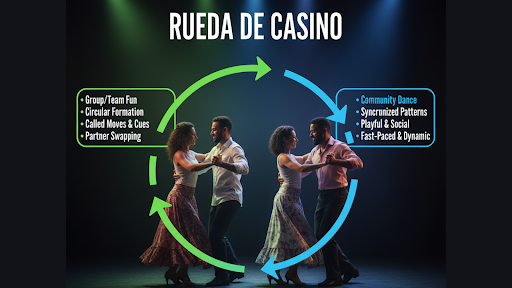
4. Rueda de Casino
Rueda is a group salsa—multiple couples dance, Casino in a circle, performing synchronized moves and switching partners on a caller's commands. It's part dance, part team sport, part organized chaos. The caller (cantante) shouts move names, and everyone executes simultaneously. Miss a call, and you crash into three other couples.
The Key Movement:
Dame (Give Me): This is the basic partner switch. On the caller's shout of "Dame!" or "Dame dos!" (give me two):
All leads release their current partner
Rotate clockwise to the next follow (or skip one for "dame dos")
Reconnect and continue dancing
This happens every 8 counts, creating a constant rotation of partners
Practice This:
Form a circle with at least 3 couples (6 couples is better). Everyone does a basic Dile Que No. On count 5, release your partner, take two steps clockwise, and grab the next person's hand on count 1 of the next phrase. Repeat. The challenge is timing—everyone must switch simultaneously or the circle collapses.
The Music:
Tempo:Moderate to fast (130-180 BPM)
What to listen for: Songs with clear phrasing and instrumental breaks work best. The caller uses musical accents to time complex moves—a horn hit might trigger a "Dame dos" call, creating a dramatic partner switch.
Common Beginner Mistake:
Not listening to the caller. Beginners get so focused on their footwork that they miss calls, creating a domino effect of confusion. One person goes left when everyone else goes right, and suddenly the circle implodes.
The Fix:
Develop "split attention"—60% of your awareness on the caller, 40% on your partner. In Rueda, following the calls is MORE important than perfect technique. It's better to execute a move poorly but synchronized than to do a beautiful move out of sync with the group.
Rueda Etiquette:
Rotate fairly:Don't skip partners or hover near your favorite dancers
Stay in the circle: If you need a break, exit completely—don't stand in the middle
Encourage beginners: Rueda falls apart if experienced dancers get frustrated with newbies
Follow the caller:Even if you disagree with a call, do what they say—consistency matters more than correctness
Also read -How Long Does It Take to Learn Salsa? Timelines & Tips
Linear vs Circular Salsa Styles
How to Choose the Right Salsa Style
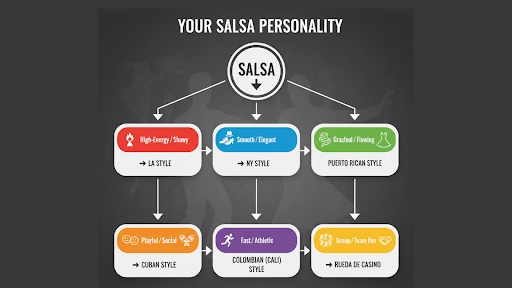
Not sure which salsa style fits you? Here’s a quick guide:
LA Style (On1): Energetic and fun, great for beginners and showy moves.
New York Style (On2): Smooth and elegant, perfect for feeling the music.
Puerto Rican Style: Flowing and graceful, ideal for expressive footwork.
Cuban Style: Playful and social, best for improvising with a partner.
Colombian (Cali) Style: Fast and athletic, perfect for performance and fitness.
Rueda de Casino: Group-based, fun, and perfect for parties or team dancing.
Tip: Try different styles to see which matches your energy and personality.
Find Your Salsa Rhythm at RF Dance Center, Orange County
Salsa is more than just steps—it’s fun, social, and a way to express yourself. At RF Dance Center, you can:
- Book your first class today!
Learn multiple styles in a friendly, no-partner-needed environment
Get step-by-step guidance from an experienced instructor
Build confidence on the floor and join local salsa socials
So, are you ready to take a step ahead in your salsa journey??
Book your first class today!
FAQs
1. How many types of salsa dancing are there?
There are 6–8 main styles: LA, NY, Cuban, Colombian (Cali), Puerto Rican, Miami, and Rueda de Casino.
2. Which salsa style is easiest for beginners?
LA style (On1) is easiest due to clear steps and a beginner-friendly structure.
3. What’s the difference between LA and NY salsa?
LA style breaks on beat 1 (On1), while NY style breaks on beat 2 (On2) for smoother timing.
4. Is Cuban salsa the same as Rueda?
No. Rueda is a group version of Cuban salsa with partner rotations guided by a caller.
5. Do I need a partner to learn salsa?
No! RF Dance Center offers rotating partners and classes designed for beginners without a partner.