How to Learn Salsa Dancing for Beginners — Solo Practice Guide

Posted on - 06 July 2026

practice Solo Salsa

Key Takeaways

  • You do not need a partner to start learning salsa — solo practice builds the foundation every beginner needs.

  • Timing comes before everything else. If you cannot find the beat, more steps just give you more ways to go wrong.

  • The basic forward-back step, side step, and 8-count rhythm are the only things you need in week one.

  • A 15-minute daily practice routine at home is enough to build real muscle memory over time.

  • Videos can help you understand movement, but classes give you feedback, posture correction, and partner connection that self-practice cannot replicate.

  • Filming yourself is the single most underrated tool for solo learners — it shows you what you cannot feel.

No partner. No studio. No problem.

Most people assume salsa is a partner dance — and it is. But the skills that make you a great partner are almost all built alone: timing, footwork, body movement, turn technique, and musicality. Every great salsa dancer spent hours practising by themselves before they ever hit a social dance floor.

Not sure how to learn salsa dancing for beginners without the help of a partner or a class? That is exactly what this guide covers — step by step, from your very first basic to your first 15-minute solo practice routine.

How to Learn Salsa Dancing for Beginners: Quick Answer

Short on time? Here is the beginner starting point in plain language.

Salsa follows an 8-count rhythm. You step on counts 1, 2, 3 — pause on 4 — then step on 5, 6, 7 — pause on 8. Everything in salsa is built on this pattern. Here is what a beginner should do first, in order:

  1. Learn the 8-count rhythm — clap along to a salsa song until you can find the '1' beat consistently.

  2. Master the basic forward-back step — left foot forward on 1, right in place on 2, left back to center on 3, pause on 4. Then right foot back on 5, left in place on 6, right to center on 7, pause on 8.

  3. Add the side step — once the forward-back feels automatic, practice stepping side to side on the same 8-count pattern.

  4. Work on hip movement — let your hips respond naturally to your weight transfers. Do not force it. It comes from proper weight shifting, not from wiggling.

  5. Practice turns solo — spot a fixed point on the wall, step forward on 1, begin the turn on 2, complete on 3.

  6. Film yourself — watch the recording. This is the fastest way to catch timing errors and body posture issues without an instructor.

  7. Take a class — solo practice builds your foundation; a class gives you the feedback and partner connection that self-practice cannot.

Keep reading for the full breakdown of each step, the beginner roadmap, home practice setup, and a 15-minute daily routine.

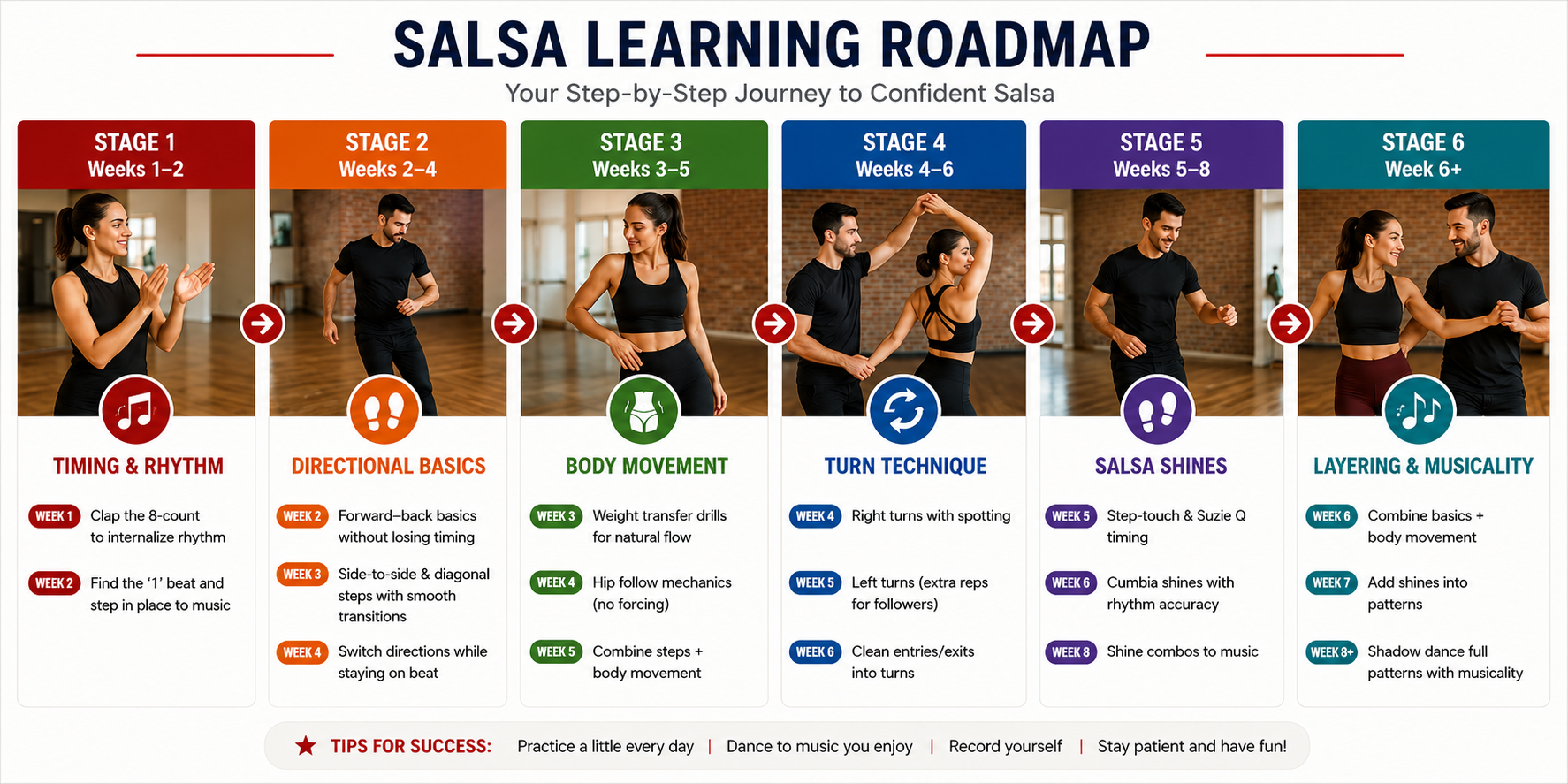
Beginner Roadmap: What to Learn First in Salsa

practice Solo Salsa

One of the most common mistakes beginners make is trying to learn patterns and moves before they have a foundation. The result is what experienced dancers call 'beginner's hell' — you know steps, but you cannot social dance. You overthink mid-song. You fall off the beat. You forget everything under pressure.

The fix is learning in the right order. Use this roadmap as your progression guide:

Stage 1 — Timing and Rhythm (Week 1-2)

Everything in salsa depends on timing. Before you learn a single step, spend time just listening to salsa music. Find the '1' beat — the downbeat where the clave hits. Clap along. Walk in place on the beat. This is the single most important skill in salsa and the most skipped by beginners.

  • Listen to salsa music daily, even just 10 minutes

  • Clap on beats 1, 2, 3 — pause — 5, 6, 7 — pause

  • Practice stepping in place on beat before adding directional movement

  • Do not move to footwork until you can stay on beat for a full song

Stage 2 — Basic Steps in All Directions (Week 2-4)

Once your timing is solid, learn the basic step in every direction. Most beginners only drill forward and back — this creates a limitation later when you need versatility on the social floor.

  • Forward and back basic (the foundation of all salsa)

  • Side to side basic

  • Diagonal steps (45-degree angle forward and back)

  • Practice switching between directions without losing the beat

Stage 3 — Body Movement (Week 3-5)

Body movement is what makes salsa look like salsa. It is not a style choice — it is technique. When you transfer weight correctly, your hips move naturally. When your core is engaged, your upper body follows.

  • Practice weight transfer with a slight bend in the knees

  • Let your ribcage shift with each step — do not hold your upper body stiff

  • Work on hip isolation: move hips independently of shoulders

  • Cuban motion comes from proper weight shifts, not from forcing hip movement

Stage 4 — Turn Technique (Week 4-6)

Turns are where most beginners struggle. Practice them solo before you ever attempt them with a partner. The key is spotting — keeping your eyes fixed on one point while your body rotates.

  • Practice right turns on the correct timing (step forward on 1, turn on 2, complete on 3)

  • Use spotting to stay balanced and avoid dizziness

  • Practice on a smooth surface with socks to simulate dance floor conditions

  • Left turns are harder — spend extra time here if you are a follower

Stage 5 — Salsa Shines (Week 5-8)

Shines are solo footwork patterns — the moments in salsa when partners break apart and dance individually. Learning shines solo develops coordination, timing variation, and personal style.

  • Start with simple step-touch and cumbia-style shines

  • Add Suzie-Q steps once your basic footwork is clean

  • Practice shines to music, not just in silence — the timing must work with the beat

  • Shines are also what you do at a social when you want to express yourself

Stage 6 — Layering Skills (Week 6 onward)

Once you have each element separately, start combining them. Basics with body movement. Shines with turns. Body movement with musicality. This is where solo practice starts to feel like actual dancing.

  • Never rush to layering — if one element breaks down when you add another, go back and isolate

  • Film yourself layering to check that your timing holds when skills combine

  • Shadow dance: run through full patterns with an imaginary partner

  • The goal is for the foundation to feel automatic so your brain is free to enjoy the music

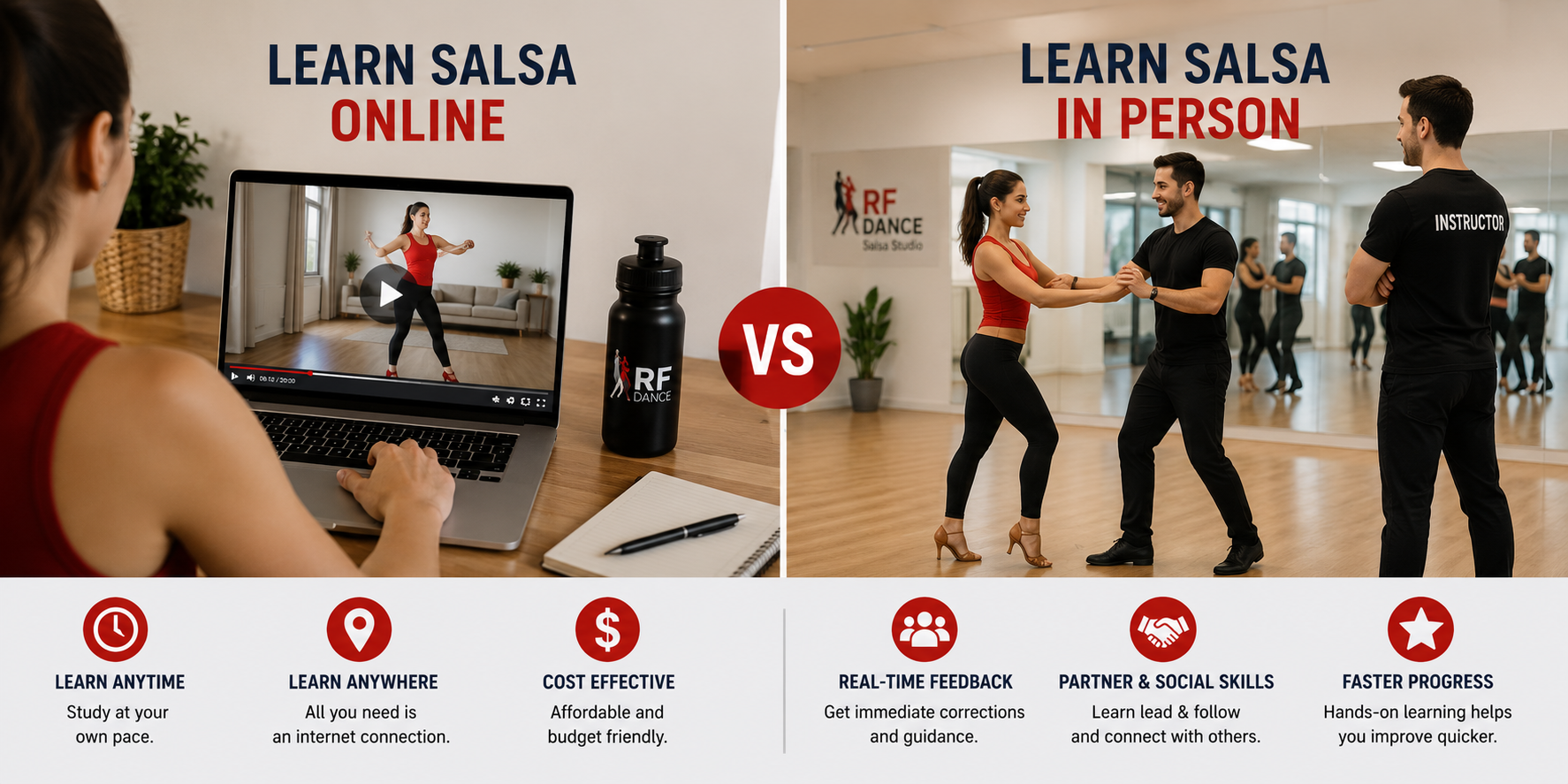
Can You Learn Salsa from Videos?

practice Solo Salsa

Yes — and no. The honest answer is: it depends on what you are trying to learn and how you use them.

Learning Method

Good For

Limitation

Self-guided video learning

Footwork patterns, timing in action, shines, body movement concepts, self-paced replay

No posture correction, no timing feedback, no partner connection

Structured written guide (this page)

Step-by-step progression, practice routines, understanding the 'why' behind technique

Cannot demonstrate movement visually — film yourself instead

RF Dance group classes

Real-time feedback, partner connection, correction of technique errors, community

Fixed schedule, in-person only

What videos are genuinely good for

  • Understanding footwork patterns visually — seeing the step is faster than reading it

  • Watching timing in action — you can count along and see exactly where the beat lands

  • Learning shines and body movement concepts that are hard to describe in text

  • Reviewing at your own pace — pause, rewind, slow down until it clicks

  • Inspiration and motivation — watching great dancers reminds you what you are working toward

Where videos fall short

  • They cannot correct your posture. You can watch perfect hip movement for an hour and still hold your body wrong without knowing it.

  • They cannot give feedback on your timing. You feel on beat even when you are not — video playback of yourself is the only way to check.

  • They do not replace a partner connection. Leading and following are physical conversations that require a real partner to develop.

  • Disconnected clips with no progression order do not build a foundation — they just give you more steps without the skills to use them.

The RF Dance approach

At our Santa Ana studio, we see students every week who have been watching salsa tutorials for months but still cannot dance salsa socially confidently. The missing piece is almost always feedback — an instructor who can see that your heel is dropping on the back step, or that your frame collapses on the turn, or that you are half a beat behind and do not know it.

Videos are a tool. Classes are the training. Use both — but know which one does what.

How to Set Up Your Salsa Practice Space at Home

practice Solo Salsa

You do not need a studio. You need a few square meters of space and the right setup. Here is what actually makes a difference:

Element

Best Option

Acceptable

Avoid

Floor surface

Smooth hardwood, laminate, tile

Low-pile carpet with socks

Thick rugs, uneven surfaces

Footwear

Leather or smooth-sole indoor shoes

Socks on a hard floor

Bare feet, rubber-soled trainers

Mirror

Full-length (feet to shoulder)

Any mirror showing the upper body

No mirror: use phone on stand

Music

Bluetooth speaker, 160–170 BPM for beginners

Phone speaker (acceptable)

TV speakers (bass distortion)

Space

3x3 m for turns; 2x2 m for basics

Hallway for linear drills

Furniture-filled rooms

Floor Surface

  • Best: Smooth hardwood, laminate, or tile floor. These surfaces allow the foot pivots that salsa requires.

  • Acceptable: Low-pile carpet if you wear socks — not ideal for pivots but workable for basic steps.

  • Avoid: Thick carpet, rugs, or uneven surfaces. These grip your foot during turns and put stress on your knees.

  • Carpet tip: Wear socks with a smooth sole on one foot — this mimics suede-sole dance shoes and allows pivots.

Footwear

  • Practice in the same shoes you plan to dance in — consistency builds the right muscle memory.

  • For home practice: clean indoor shoes with a leather or smooth sole, or socks on a hard floor.

  • Avoid bare feet — you lose the feel of proper weight distribution and pivot technique will not transfer.

Mirror

  • A full-length mirror that shows feet, hips, and shoulders simultaneously is ideal.

  • No mirror? Use your phone on a selfie stand and record — this is actually more useful because you can watch back frame by frame.

Music Setup

  • Use a Bluetooth speaker rather than phone speakers — sound quality affects your ability to hear the clave and find the beat.

  • Spotify, YouTube Music, and Apple Music all have salsa playlists. Search 'salsa on1 practice music' or 'salsa music beginner tempo' for slower tracks.

  • Start with songs at 160-170 BPM for beginner practice. Work up to 185-200 BPM as your timing becomes solid.

Space Requirement

You only need a 2x2 meter area for basic step practice. For turn practice, clear at least 3x3 meters to complete a full rotation without bumping into anything.

15-Minute Beginner Salsa Practice Routine

This routine is designed for complete beginners practising at home without a partner. Do it daily or at least 4 times a week. Consistency matters more than duration.

What you need: A clear floor space, salsa music, your phone to record (optional but recommended).

Time

Activity

Focus

Tip

Mins 1-3

Timing Warm-Up

Count out loud to a salsa song. Step in place on the beat only.

Find the '1' before you add footwork.

Mins 3-7

Basic Steps

Forward-back (leaders/followers), then side step for final minute.

Pause on 4 and 8 — do not rush.

Mins 7-10

Body Movement Drill

Slow weight transfer — let hips follow naturally.

Cuban motion comes from weight shift, not forced wiggle.

Mins 10-13

Turn Practice

Right turns with spotting. 8 reps, then 4 left turns.

Fix your eyes on one point — snap head around to find it.

Mins 13-15

Free Dance + Review

Full salsa song freestyle. Watch your recording — pick ONE fix.

One improvement per session. Not five.

Minutes 1–3: Timing Warm-Up

Put on a salsa song. Do not move yet — just listen. Find the beat. Count along out loud: 1, 2, 3, pause, 5, 6, 7, pause. Once you can feel the pattern, start stepping in place on the beat. No direction yet — just stepping and counting. This locks your internal clock in before you add footwork.

Minutes 3–7: Basic Steps

Still with the music playing, move into your basic forward-back step.

For leaders:

  • Count 1: Step forward with left foot

  • Count 2: Step in place with right foot

  • Count 3: Bring left foot back to centre

  • Count 4: Pause (weight stays)

  • Count 5: Step back with right foot

  • Count 6: Step in place with left foot

  • Count 7: Bring right foot back to centre

  • Count 8: Pause

For followers:

  • Count 1: Step back with right foot

  • Count 2: Step in place with left foot

  • Count 3: Bring right foot back to centre

  • Count 4: Pause

  • Count 5: Step forward with left foot

  • Count 6: Step in place with right foot

  • Count 7: Bring left foot back to centre

  • Count 8: Pause

Once the forward-back feels solid, spend 1 minute on the side step: step left on 1, bring feet together on 2, step left again on 3, pause on 4 — then reverse to the right.

Check: Are you stepping on the correct beats? Are you pausing on 4 and 8, or are you rushing through?

Minutes 7-10: Body Movement Drill

Stop the footwork. Stand still and focus only on your body.

  • Shift your weight to your left foot — let your left hip drop naturally as the right leg straightens slightly.

  • Shift your weight to your right foot — let your right hip drop naturally.

  • Do this slowly, back and forth, feeling the hip movement that comes from weight transfer.

Now add it back to the basic step. Do not force your hips — just shift your weight correctly and let the hips follow. This is Cuban motion. It takes weeks to feel natural, so be patient.

Minutes 10-13: Turn Practice

Practice right turns solo.

  • Step forward on 1

  • Begin turning on 2 (pivot on your front foot)

  • Complete the turn to face forward on 3

  • Pause on 4

  • Return to basic on 5-6-7-8

Spotting: Pick a fixed point on the wall. Keep your eyes on that point as long as possible as you turn, then snap your head around quickly to find it again on the other side. This is spotting — it keeps you balanced and oriented.

Do 8 repetitions of the right turn, then rest. If you are working on left turns, add 4 left turn repetitions here.

Minutes 13-15: Free Dance + Self-Review

Put on a full salsa song and freestyle for 2 minutes. Use everything you have practiced — basics, side steps, body movement, a turn or two. Do not overthink it. Let the music guide you.

After the song, if you recorded yourself, watch the clip once through without judgment. Then identify one thing to improve in your next session. Write it down.

One thing to fix per session. Not five. One.

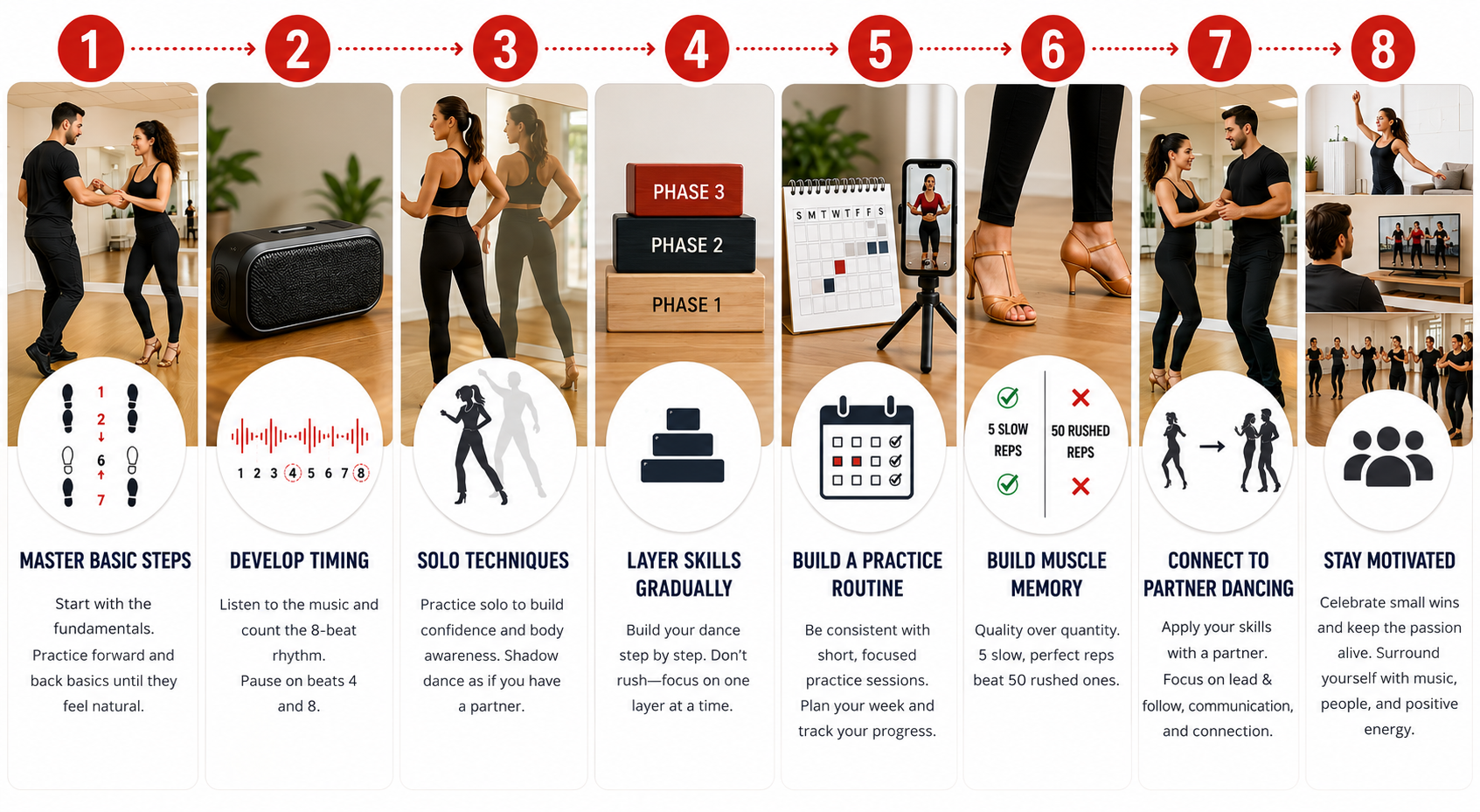
Step 1: Master Your Basic Steps

practice Solo Salsa

Start with the basic forward-and-back movement. Whether you are leading or following, the timing and rhythm of your steps will create the structure of your dance. This is the vocabulary of salsa — you need it before you can have a conversation on the dance floor.

For Leaders:

  • Count 1: Step forward with your left foot

  • Count 2: Step in place with your right foot

  • Count 3: Bring your left foot back to centre

  • Count 4: Pause

  • Count 5: Step back with your right foot

  • Count 6: Step in place with your left foot

  • Count 7: Bring your right foot back to centre

  • Count 8: Pause

For Followers:

  • Count 1: Step back with your right foot

  • Count 2: Step in place with your left foot

  • Count 3: Bring your right foot back to centre

  • Count 4: Pause

  • Count 5: Step forward with your left foot

  • Count 6: Step in place with your right foot

  • Count 7: Bring your left foot back to centre

  • Count 8: Pause

Tip: Practice slowly at first to make sure you stay on beat and maintain proper form. Once this feels solid, explore the top beginner salsa dance moves to build your vocabulary.

Step 2: Develop Timing and Musical Awareness

One of the key elements of learning salsa is syncing your movements with the music.

Understand the 8-Count Rhythm

Salsa music follows an 8-count pattern:

  • Counts 1-2-3: Step, step in place, bring feet together

  • Count 4: Pause

  • Counts 5-6-7: Step, step in place, bring feet together (opposite direction)

  • Count 8: Pause

The more time you spend listening to salsa music without trying to dance, the faster your timing will improve. Train your ear first.

Step 3: Practice Advanced Solo Techniques

Shadow Dancing

Imagine you are dancing with an invisible partner and run through complete patterns. This technique lets you practice positioning, frame, and lead/follow dynamics without distraction. Start with simple patterns — basic steps with right turns, cross-body leads, and reverse turns. Focus on maintaining proper frame (elbows in front of hips) and staying centred as your imaginary partner moves around you.

Salsa Shines

Shines are solo footwork patterns that allow dancers to showcase individual style during partner breaks. They are the perfect solo practice tool — every shine you build alone translates directly to partner dancing. Start with simple step-touch patterns, then add the suzie-q and cumbia step once your basic timing is solid. Coordination, timing, and personal flair all develop through shines.

Turn Technique

Turns are the most important skill for followers to master solo. Practice both right and left turns separately. Focus on technique rather than speed — a slow, controlled turn on the right beat is worth more than a fast, sloppy one.

For right turns:

  • Step forward on 1

  • Turn in place on 2

  • Complete the turn on 3

  • Return to basic on 5-6-7

Use spotting (fixing your eyes on one point while turning) to maintain balance and reduce dizziness. Practice on different surfaces and consider using socks on a smooth floor to simulate dance shoe conditions.

Body Movement and Style

Lead all movement from your core rather than just moving your legs. When you step side to side, let your ribcage shift with your steps. When stepping right, let your ribcage move slightly left as your weight shifts — this creates the counterbalance that makes salsa body movement look natural. Use body isolation exercises — move your ribs independently of your hips, and your hips independently of your shoulders. Then combine them with footwork for that signature salsa style.

Step 4: Layer Skills Gradually

Phase 1 — Master Basic Rhythm

  • Practice stepping on the correct beats

  • Drill basic steps in all directions: forward, back, side, diagonal

  • Walk on two parallel lines to build stability and consistent spacing

  • Focus on the balls of your feet for agility and quick weight transfers

  • Practice with both slow and fast music to test your timing at different speeds

Build body mechanics:

  • Practice hip movement through correct weight transfer — shift to a bent leg while straightening the other

  • Use your core for rotational movement, especially during turns

  • Maintain posture: head up, chest open, shoulders back and relaxed

Phase 2 — Add Body Movement and Styling

  • Add subtle ribcage and hip shifts as you transfer weight in the basic

  • Isolate and combine movements: ribcage, then hips, then shoulders, then all together

  • Practice stylistic accents like chest pops and hip rolls — slowly at first

  • Start simple footwork shines and coordinate arm movements with weight transfers

Phase 3 — Combine and Refine

  • Layer skills: basics first, then add body movement, then shines, then turns

  • Film your practice every 2 weeks and compare to earlier recordings

  • Shadow dance to music, visualising a full partner interaction

  • Practice freestyle: put on a song and dance without planning each move — this builds musicality

Step 5: Build a Structured Practice Routine

Weekly Training Schedule

Treat salsa practice like training — structured and consistent. A sample week for beginners:

  • Monday / Wednesday / Friday: 10-15 minutes of body movement and basic step drills

  • Tuesday / Thursday: 20-30 minutes of shines, footwork, and turn practice

  • Weekend: Shadow dancing, pattern memorisation, and free freestyle to full songs

Use Technology

Record yourself practising. It feels awkward the first few times — do it anyway. The camera catches what you cannot feel: a heel that drops on the back step, a frame that collapses mid-turn, a rhythm that rushes on the 5 count. Watch each recording once without judgement, then pick one thing to fix.

Step 6: Build Muscle Memory and Confidence

Memorize Your Dance Vocabulary

Dancing is a language. You need vocabulary — individual steps — before you can build patterns, and patterns before you can social dance freely. After each practice or class, write down every move you worked on. Run through them solo before you forget. Even walking through footwork without music locks it in.

The dancers who look smooth are not improvising everything. Their body has internalised the movements so deeply that the steps feel automatic. That is muscle memory — and it only comes from repetition.

Practice mantra: if you cannot do it alone, you cannot do it with a partner.

Focus on Quality Over Quantity

Five slow, correct repetitions of a step will build better muscle memory than fifty rushed ones with poor form. Practice slowly enough that you cannot hide your mistakes — that is the speed at which real improvement happens.

Step 7: Connect Solo Practice to Partner Dancing

Practice Lead and Follow Roles

Even in solo salsa practice, keep your role in partner dancing in mind. Leaders should focus on maintaining a strong frame and clear lead positioning while executing patterns. Followers should focus on turn technique, body awareness, and responsiveness — practising what it feels like to respond to a signal, not anticipate it.

Transition to Partner Work

Solo practice is not a replacement for partner dancing — it is the preparation for it. The timing, technique, confidence, and muscle memory you build alone create the foundation that makes partner work feel natural rather than overwhelming. When you are ready for the next step, salsa dance classes in Orange County give you real-time feedback and partner connection that solo practice cannot replicate.

Step 8: Stay Motivated and Engage with the Community

Set Realistic Goals

Consistency beats intensity every time. Even 10 to 15 minutes of daily practice builds more than a single two-hour session once a week. Focus on steady progress and celebrate small wins. The first time your hip movement feels natural. The first clean right turn. The first time you stay on beat through an entire song. These are real milestones.

Watch Great Dancers

Watching experienced salsa dancers is an active learning tool, not passive entertainment. Go to a social dance night and take breaks between dances to observe. Find dancers whose movement you admire and study them — how they transfer weight, how they time their turns, how their bodies respond to the music. Then bring one observation back to your next solo practice session.

Join a Dance Community

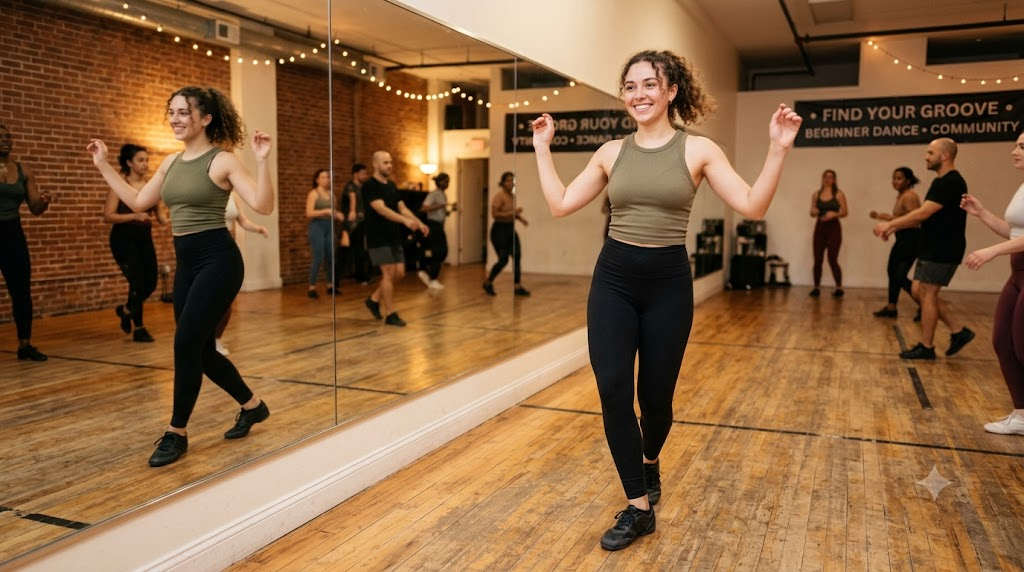
Solo practice takes you far — but it takes you further when you have a community around it. At RF Dance in Santa Ana, we run 55+ group classes every week in Salsa, Bachata, Cumbia, and Banda. All levels welcome. No partner required to join.

Your First Salsa Class in Orange County — Just Show Up

Now you know exactly what to wear for salsa dancing. The rest is showing up.

At RF Dance in Santa Ana, your first class needs nothing more than: comfortable, fitted clothing you can move in, flat-soled shoes (or the cleanest sneakers you own), and the willingness to try something new.

We have 55+ group classes every week in Salsa, Bachata, Cumbia, and Banda. All levels. All welcome. No partner required.

Frequently Asked Questions (FAQs)

1. Is salsa easy to learn?

Salsa is not inherently difficult, but it takes time and practice to master.

2. How long does it take to learn salsa?

It depends on individual to individual. However, you may expect to learn with 12 to 20 hours of lessons and practice.

3. Can you learn salsa without a partner?

Yes, you can learn salsa without a partner by focusing on solo practice, including the basic steps, footwork, and body movement through techniques like “shadow dancing”.

4. What are the basic steps of salsa?

The basic salsa step include a “forward and back” or “side to side” pattern with a weight transfer on the “1” and “5” counts, a movement on the “2” and “6” counts and a completion/closing step on the “3” and “7” counts, pausing on the “4” and “8” counts.

5. What are some common salsa mistakes?

Here are the common mistakes:

  • Not listening to the music

  • Rushing through the steps

  • Looking at the feet

  • Overcomplicating movements

  • Not understanding timing in salsa

  • Forget the basic step

6. What is a salsa dancing outfit for beginners?

The ideal salsa dancing outfit for beginners is simple: a fitted, breathable top (tank, tee, or crop top) with stretchy leggings, fitted joggers, or a practice skirt for women; and a fitted polo or button-down with slim chinos for men. Pair it with flat-soled shoes or dance flats. Comfort and freedom of movement matter far more than style at this stage.

7. What to wear to salsa night at a social club or event?

Salsa night calls for a smart-casual salsa dress code. Women typically wear a flared or midi skirt with a fitted top, or a wrap dress. Men wear a fitted shirt with tailored trousers. Upgrade your shoes — Latin dance heels for women and leather-soled loafers or dance shoes for men. The goal is looking intentional while still being able to dance all night without restriction.

8. How to dress for salsa dancing if you are plus-size or body conscious?

Salsa is for every body, and the outfit advice is the same regardless of size: fitted but comfortable, breathable, and free to move. High-waisted leggings and a well-fitted top are universally flattering and functional. What you wear on the dance floor matters far less than showing up. At RF Dance, every level and every body is welcome.

9. Do salsa dancers wear a specific colour?

There is no required colour for salsa dance attire. In performance settings, costumes are often bold — deep reds, blacks, and bright jewel tones are popular in Latin dance aesthetics. For class or social nights, wear whatever makes you feel confident and comfortable. The only rule is that your outfit must allow you to move freely.

Interested? Find a class online.