 RF Dance

Bachata
Key Takeaways:
Bachata originated in the Dominican Republic during the early 1960s, evolving from musical influences such as bolero, son, and merengue.
The word "Bachata" originally referred to informal social gatherings before becoming the name of the music and dance style.
Bachata was never officially banned by law, but it faced widespread social stigma and exclusion from mainstream media.
Early Bachata was often associated with working-class communities, cantinas, and red-light districts, leading to class-based prejudice.
Religious groups and conservative critics viewed Bachata's close partner connection and sensual movements as inappropriate.
Radio Guarachita played a crucial role in keeping Bachata alive when most mainstream outlets refused to support it.
Artists such as José Manuel Calderón, Leonardo Paniagua, Blas Durán, Juan Luis Guerra, and Aventura helped transform Bachata from a marginalized genre into a global phenomenon.
The release of "Bachata Rosa" (1990) and "Obsesión" (2002) significantly accelerated Bachata's international popularity.
Today, Bachata is danced in more than 50 countries, taught in thousands of dance schools, and celebrated at international festivals and competitions.
Today, Bachata fills dance floors in over 50 countries, from clubs in Madrid and Berlin to festivals in Tokyo and Cairo, and is celebrated through an international circuit of 28 qualifying events, all culminating in the Bachata Social World Cup Finals in Geneva in October 2026. However, it wasn’t always like this! This dance was once stigmatized as ‘low-class’ and kept off most mainstream radio/TV.
Even without a legal ban, it felt “forbidden,” and this social exclusion led to many myths that still surround it today. If you are a beginner looking to join Bachata classes, you have probably wondered the following:
Why was it considered "low-class" in the past?
How did it overcome its stigma and become popular?
"Is it considered a sin to dance Bachata?
The transformation of this dance style from being shunned to becoming a global favorite is fascinating- and we are discussing it all here. Keep reading this blog to explore bachata history, its ban, comeback, and rise into one of the world's most popular social dances.
Before learning what to expect in your first bachata class and how to walk in ready for it, let's take a look at understanding where this dance came from and how it evolved from a local Dominican tradition into a global phenomenon.
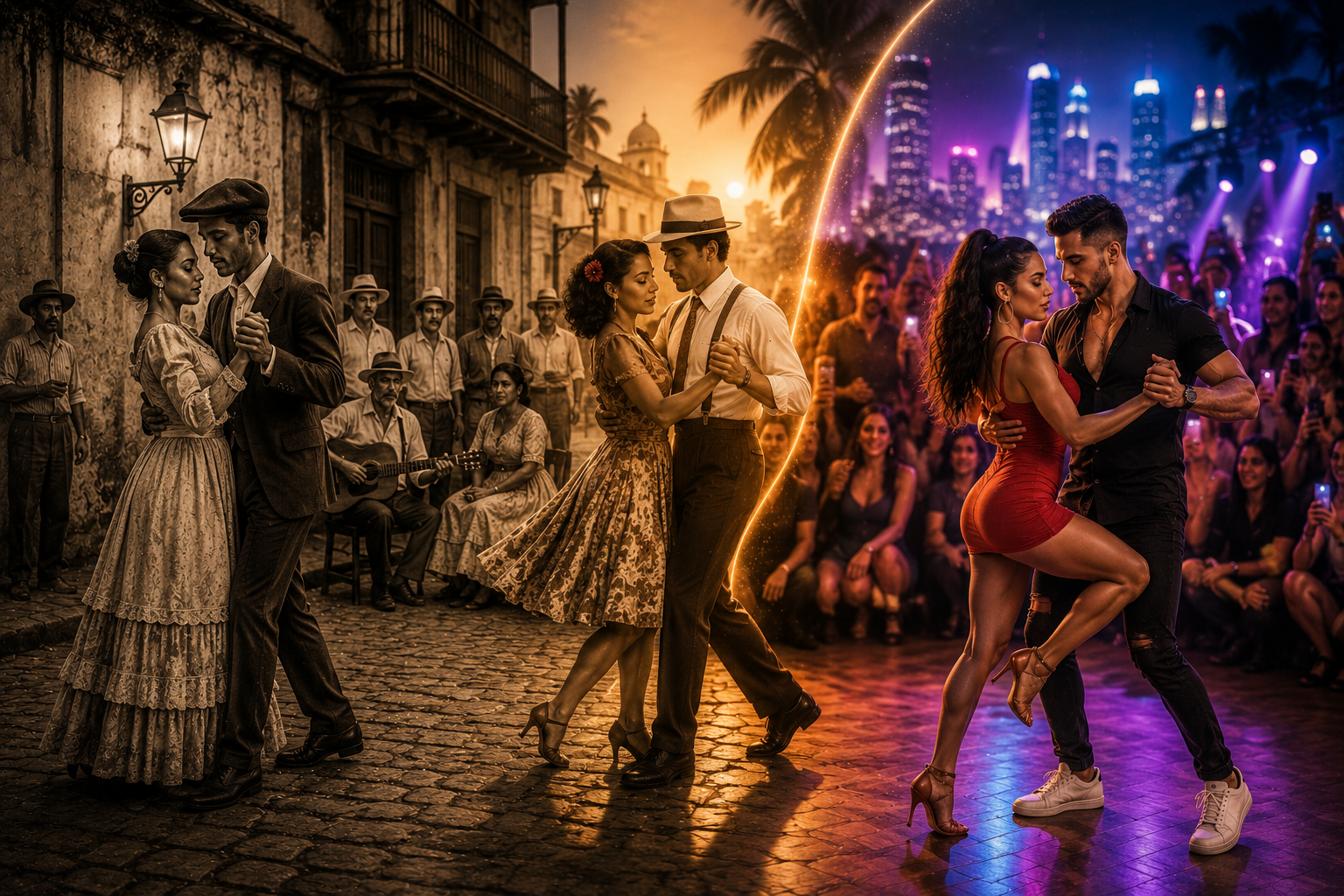
The bachata origin story begins in the Dominican Republic during the early 1960s, combining elements of bolero, son, and merengue. The term "Bachata" originally referred to an informal working-class gathering before becoming the name of the music and dance style.
After the Trujillo dictatorship, elites and programmers prioritized “high culture” and ballroom-polished merengue. Bachata is nicknamed música de amargue (“music of bitterness”) for its raw, heart-on-sleeve lyrics.
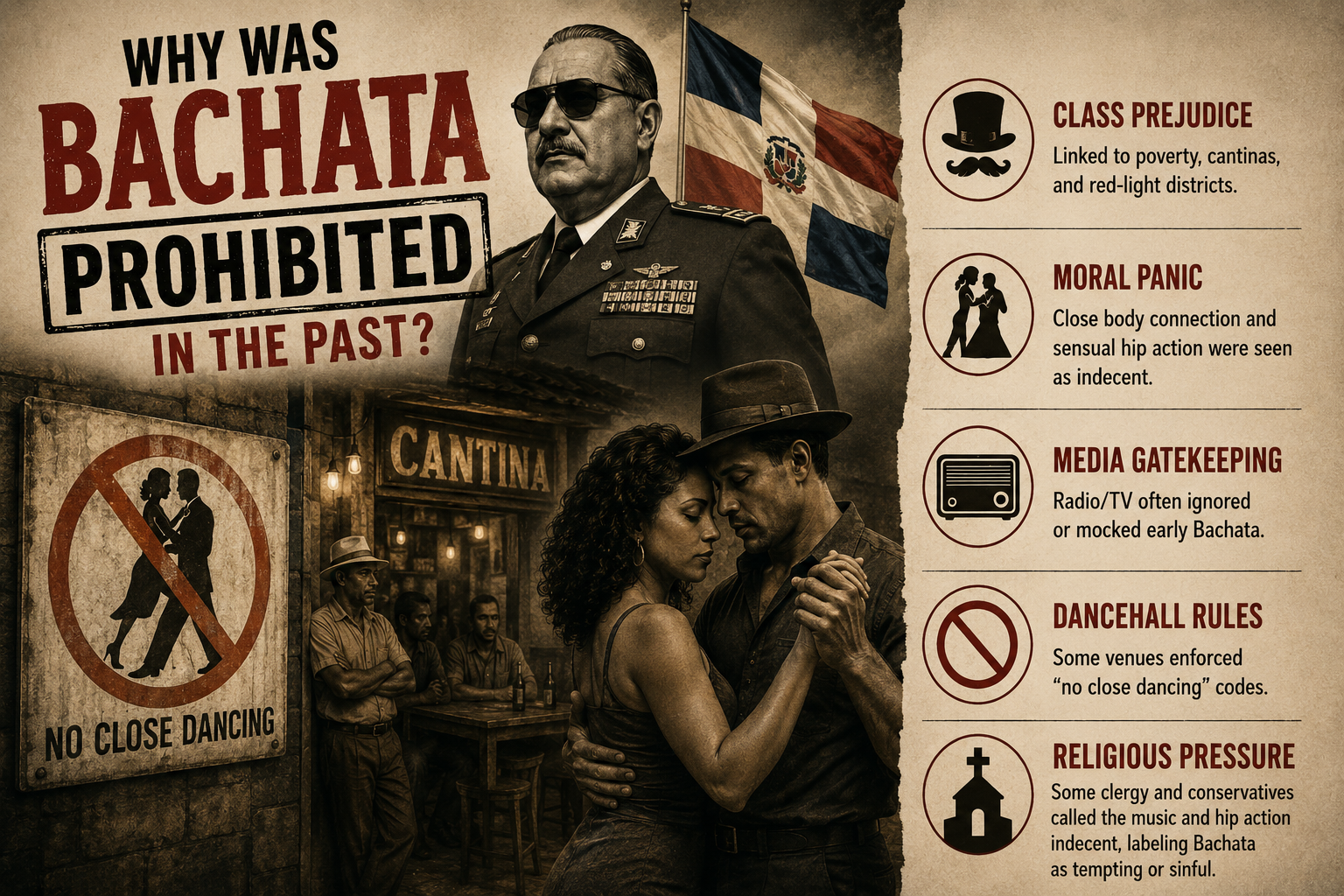
Bachata, known for its raw and emotional lyrics, was seen as vulgar and was blacklisted from mainstream platforms, associating it with low-class bars and brothels. It wasn’t “forbidden” by the law, but it was shunned, censored, or discouraged in many spaces. The “forbidden” label reflects social policing as much as legal rules.
Here are the reasons for the Bachata social ban with quick details:
Issue | Description |
Class Prejudice | Linked to poverty, cantinas, and red-light districts. |
Moral Panic | Close body connection and sensual hip action were seen as indecent. |
Media Gatekeeping | Radio/TV often ignored or mocked early Bachata. |
Dancehall Rules | Some venues enforced “no close dancing” codes. |
Religious Pressure | Some clergy and conservatives called the music and hip action indecent, labeling Bachata as tempting or sinful. |
No, dancing Bachata is not a sin! For some religious groups, its close frame and sensual style raise concerns. But Bachata is a cultural expression and a social partner dance.
Most dancers practice consent, respect, and technique, not provocation. Today, countless community centers and family-friendly festivals celebrate it without controversy.
The bottom line?
Bachata's early challenges were driven more by social perceptions than by legal restrictions. Today, it is recognized as a respected cultural tradition and enjoyed by dancers across the globe.
It’s time to explore bachata music history, which reveals how the genre evolved from local Dominican recordings into a globally recognized musical style.
Take a look at the table below:
Stage | History Of Bachata Dance and Music | Significance |
Origin (1960s) | Bachata begins in the Dominican Republic | Reflects the love and heartbreak of the working class. |
Formation (1962) | José Manuel Calderón records Bachata’s first commercial songs. | Officially marks Bachata as a genre. |
Early Struggles (1960s-70s) | Bachata is ignored by mainstream media and seen as “low culture.” | Remains underground |
Survival (1960s-70s) | Radio Guarachita keeps Bachata on air | The only station to consistently play Bachata, helping it survive. |
Growth (1970s) | Leonardo Paniagua adds romantic themes. | Attracts broader audiences with a softer sound. |
Modernization (1986) | Blas Durán pioneers electric Bachata . | Updates the sound to appeal to younger generations. |
Mainstream Breakthrough (1990) | Juan Luis Guerra’s release of Bachata Rosa. | Brings global respectability and mainstream success. |
International Success (2002) | Aventura’s “Obsesión” becomes a hit worldwide. | Gains global popularity. |
New Style (2000s) | Bachata Sensual is developed in Spain by Korke Y Judith. | Introduces a new, sensual dance style. |
Global Recognition (2019) | UNESCO adds Dominican Bachata to its cultural heritage list. | Recognized as a cultural treasure. |
Ongoing Evolution (2020s) | The dance style continues to thrive in global events and festivals. | Continues evolving with new global fusions. |
This timeline highlights the most important milestones in bachata music history, from its underground beginnings to international success.
The history of bachata dance is just as layered as its music, and understanding how the movement vocabulary changed explains why bachata looks so different depending on where in the world you encounter it.
This bachata dance origin style remains the foundation on which every modern variation of Bachata is built. In this, partners hold each other in a close embrace, weight stays low, and the footwork follows a simple side-to-side pattern with a tap or pop on the fourth beat. Hip movement is natural and musical, not choreographed. The dance is entirely led by the music. Bachata dancers in the Dominican Republic say you are not dancing to the music, you are dancing with it. This bachata dance origin style remains the foundation on which everything else is built.
As bachata entered mainstream venues and competitions, its posture became more upright and its technique more codified. Cleaner footwork patterns, standardized frame, and structured turn patterns were introduced to make the dance teachable and competitive. This is the version most commonly seen in Latin dance competitions today.
Developed by Spanish dancers Korke y Judith in Cádiz, Bachata Sensual borrowed liberally from contemporary dance, zouk, and tango. It introduced body waves, dips, lateral body isolations, and theatrical pauses that had never existed in traditional bachata. The style spread rapidly through Europe's dance festival circuit in the 2010s and is now the version most commonly seen on social media, often mistaken by newcomers as "standard" bachata, when it is actually one specific stylistic evolution.
The youngest major style incorporates hip-hop footwork, street dance isolations, and movement vocabulary drawn from R&B music videos. It appeals strongly to younger dancers and is designed for the urban bachata sound of Romeo Santos, Prince Royce, and contemporary fusion artists. Footwork is more individual, partner connection is looser, and improvisation plays a bigger role.
Looking at the history of bachata dance, it becomes clear that each style reflects a different stage of the dance's global development. Curious about knowing their differences? Explore our guide to the various types of Bachata styles, their origins, and key differences.
Several forces propelled this dance style from backrooms to international stages, and understanding them helps explain why bachata's global rise wasn't luck but the accumulation of momentum over decades.
Before streaming, before social media, it was people who carried bachata across borders. Dominican communities in New York City's Washington Heights neighborhood, in Madrid's Lavapiés district, and in Rome's Latino neighborhoods kept playing and dancing bachata throughout the 1980s and 90s. They built the audience that "Obsesión" then reached at scale.
Spain's large Dominican and Latin American diaspora made it the first major non-Caribbean market to embrace bachata at scale. But it was in Italy that "Obsesión" first went viral before even breaking in the US, demonstrating that bachata could reach non-Latino audiences entirely. Italian radio stations began playing it without knowing its genre, simply because listeners were calling in to request it. That organic, border-crossing moment changed what the music industry thought bachata could be.
As bachata's music spread, demand for classes followed. Bachata is now consistently ranked among the top three most-taught partner dances globally in dance studios, alongside salsa and tango. Dance schools in cities with no Latin American community, such as Tokyo, Berlin, Sydney, and Seoul, now run regular bachata classes. This institutionalization of teaching is what transformed bachata from a music people listened to into a dance culture people actively participate in.
YouTube tutorials, Instagram reels, and TikTok bachata videos introduced the dance to millions who had never been inside a Latin dance club. Bachata-related hashtags on TikTok have accumulated billions of views, and channels dedicated to bachata sensual choreography routinely reach tens of millions of views per video. The visual nature of the dance, and specifically the dramatic, cinematic quality of Bachata Sensual, made it uniquely suited to short-form video in a way that many other partner dances were not.
Perhaps the clearest evidence of bachata's genuine global rootedness is the strength of its communities in countries with no Latin American connection. Japan, Germany, Poland, and Australia now host major bachata festivals and produce internationally competitive social dancers. When a dance from the Dominican Republic becomes a competitive pursuit for Polish and Japanese dancers, it stops being an immigrant cultural export and becomes something truly universal.
The world's formal recognition of bachata by UNESCO as Intangible Cultural Heritage in 2019 gave the genre institutional credibility it had never had and opened doors to educational and cultural funding that further accelerated its spread.
Together, these forces transformed a stigmatized local style into a mainstay of the international social dance scene.
Bachata’s journey proves that culture can outgrow stigma. What some called indecent became a global language of connection, led by guitar strings, guided by rhythm, and refined by dancers who treat closeness with skill and respect.
The next time you step onto a social floor and hear that syncopated beat, remember: you’re dancing a story that refused to be silenced. Now that you know the story behind Bachata, why not become part of it? Enroll in our Bachata Dance Classes in Orange County, CA, and learn the techniques, musicality, and partner connection that have made this dance a worldwide favorite.
Experience Salsa, Bachata, or Cumbia with Orange County’s favorite homegrown dance school- RF Dance. Sign up now and get your first class for only $5!
Unedited reviews from people who walked in without a partner and without a clue.
“RF Dance is an amazing place. The instructors are encouraging and passionate, and my daughter looks forward to her classes every single week.”Sophia M.